Iran, Oil, and Markets
Over the weekend, the United States and Israel launched a major military operation against Iran, striking strategic sites across Tehran and other cities. The targets were deliberate, aimed at degrading Iran’s nuclear program and leadership. Like quarterly commentaries, I will attempt to present the facts free of political opinions but focused on how we got here, what has transpired so far, the possible outcomes, and the effects on the economy and the market.
How Did We Get to This Point?
- High Tensions – Relations between the U.S. and Iran were already tenuous, spurred on in part due to last summer’s missile strike on the country.
- Iran’s Nuclear Program – The U.S. and allies have accused Iran of escalating uranium enrichment to levels that have no civilian application and approach weapons-grade material. However, Iran insists on its right to a peaceful nuclear program, creating a core sticking point in negotiations.
- Diplomatic Breakdown – Prior diplomatic efforts, including proposed interim accords, failed to bridge gaps over enrichment limits and ballistic missile restrictions.
- Internal Unrest – Iran’s deepening economic crisis and widespread anti-regime protests in late 2025 and early 2026 contributed to internal instability preceding the conflict.
What’s Happened So Far
- Missile Strikes – Israel and the U.S launched a barrage of missile strikes at strategic sites across Iran.
- Death of Ayatollah Ali Khamenei – Iran confirmed that Supreme Leader Ayatollah Ali Khamenei, who had led Iran since 1989, was killed during these strikes.
- Retaliatory Strikes – Iran launched missile and drone attacks against Israeli territory and U.S. military bases throughout the Middle East.
- Civilian Toll – Reports indicate substantial casualties within Iran, including civilians, with at least 201 killed and hundreds more injured.
- U.S. Losses – At least four U.S. Service members have lost their lives thus far as a result of Iran’s retaliation.
- Regional Escalation – Gulf states have seen airspace closures and incidents tied to the broader conflict. Diplomatic responses at the U.N. Security Council have called for de-escalation.
Possible Outcomes
- De-Escalation – Tempers calm and last weekend’s events become the height of this conflict. Although Iran continues to strike a defiant tone that they will inflict great pain on Israel and the United States, there are early indications that all parties are open to talking, although Iran refutes these reports.
- Continued Hostilities – The opposite possibility is that Iran follows through on its threats and continues to bomb Israel and United States military targets around the Middle East with no end in sight as Israeli and U.S. forces increase their bombing of Iran in response.
- Regional Spillover – Other countries in and outside the Middle East enter the fray, creating a larger war. This feels unlikely given that, as of now, few countries appear to be taking the side of the Iranians. Russia and China have condemned the attacks on Iran but have yet to pledge any help.
Market Implications
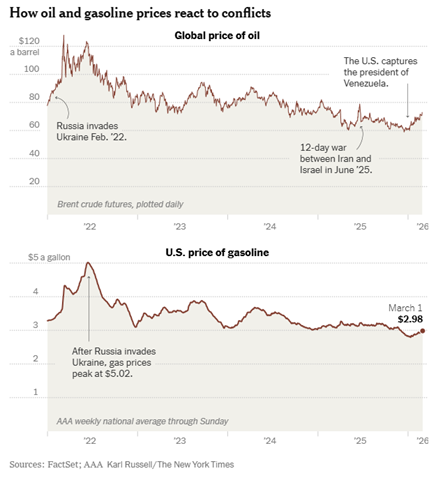
- Oil Price Volatility – Global crude prices have risen amid conflict fears, with Brent crude oil, the most widely used oil price benchmark, touching multi-month highs. Continued unrest raises the risk of broader supply disruptions, especially if tensions threaten the continued operation of the Iran-controlled Strait of Hormuz, through which 20% of the global oil supply flows.
- Even limited disruptions could see prices spike above $80–$100 per barrel if shipping through the strait is impacted. For context, the average price per barrel in 2025 was $68.19.[i]
- It’s worth noting that Iran threatened to close the Strait as recently as last June following U.S. strikes. This caused a temporary spike before prices quickly leveled out.
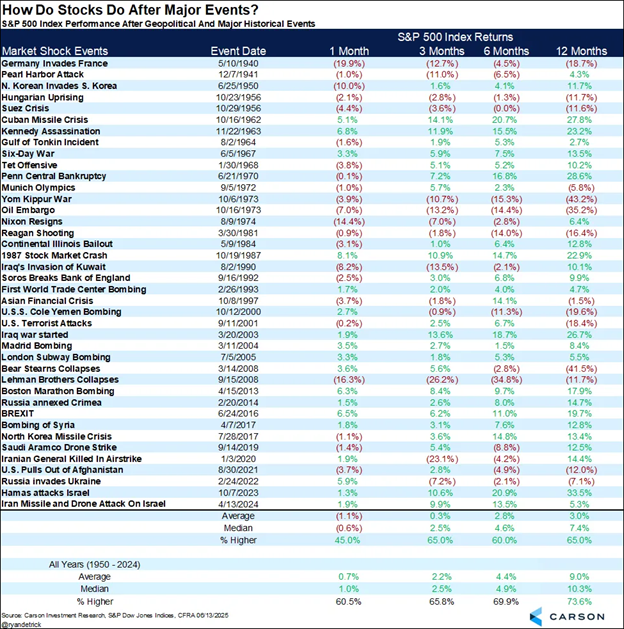
- Equity Volatility – Heightened geopolitical risk typically drives short-term selloffs in risk assets, but in past situations, equities have recovered.
- As seen in the chart below, geopolitical events typically have not led to stock sell-offs. Historically, recovery has generally been pretty quick, especially in more recent examples.
- Safe Havens – Demand for U.S. Treasuries, gold, and other defensive assets may increase amid uncertainty.
- Emerging Markets – Regions with trade ties to the Middle East may experience capital outflows and currency pressure.
This is a fast-moving situation, and even by the time you read this, the situation may have changed. The hope is for a swift resolution with limited loss of life that restores stability to the Middle East.
Whatever direction it takes, we will be here following, analyzing, and making any necessary changes to portfolios. One important thing to remember in times like this is that doing nothing is something, so unless this time is truly different, do not expect major changes in the coming days, but we will look for opportunities that the volatility creates.
As always, please reach out if you have any questions.
Will
Disclosure: The opinions in the preceding commentary are as of the date of publication and are subject to change. Information has been obtained from third-party sources we consider reliable, but we do not guarantee the facts cited are accurate or complete. This material is not intended to be relied upon as a forecast or investment advice regarding a particular investment or the markets in general, nor is it intended to predict or depict the performance of any investment. Investors should consult their financial advisor on the strategy best for them. Past performance is no guarantee of future results.
[i] https://www.reuters.com/business/energy/analysts-hike-oil-outlook-geopolitical-risks-oversupply-concerns-limit-upside-2026-02-27/
ph 678.322.3000 / fax 678.322.3059
Persium Group, LLC / 2100 Riveredge Parkway, Suite 1230 / Atlanta, GA 30328
Persium Group consists of three teams: Persium Advisors — wealth management for business owners and other investors, NAVIX — exit planning for business owners, and CoVerity — serving the needs of retirement plan committees.



The Persium Group, formerly known as White Horse, is an independently owned and operated firm that was founded in 2004. In 2010, White Horse Advisors, LLC registered with the Securities and Exchange Commission as an investment adviser allowing us to operate in a product neutral, fee-only investment environment.